
If your child has been diagnosed with autism or is showing signs of ASD, there is a good chance that ABA therapy has been recommended to you. But what does ABA actually involve? What does a session look like? And is it right for your child?
This guide explains ABA therapy in plain language — without academic jargon — so you can make an informed decision.
What Does ABA Stand For?
ABA stands for Applied Behaviour Analysis. It is one of the most extensively researched therapeutic approaches in the world for supporting children with autism spectrum disorder (ASD).
The word "behaviour" in ABA refers broadly to any observable skill or action — from making eye contact, to following instructions, to asking for help. ABA focuses on understanding why behaviours happen and systematically teaching new, more functional behaviours to replace them.
How Does ABA Therapy Actually Work?
ABA therapy is based on a straightforward but powerful principle: behaviour that is positively reinforced is more likely to happen again.
In practice, a therapist breaks a target skill down into very small, teachable steps and uses consistent, positive feedback to build each one. Two common approaches are used depending on the child:
- Discrete Trial Training (DTT): Structured, repetitive practice of a specific skill in a controlled setting. Best for learning foundational skills like pointing, matching, and following instructions.
- Natural Environment Training (NET): Skills are taught during everyday play and activities. Better for generalising skills to real-world situations.
Most programmes at Kocoon Junior blend both approaches, tailored to each child's specific needs and learning style.
What Does an ABA Session Look Like?
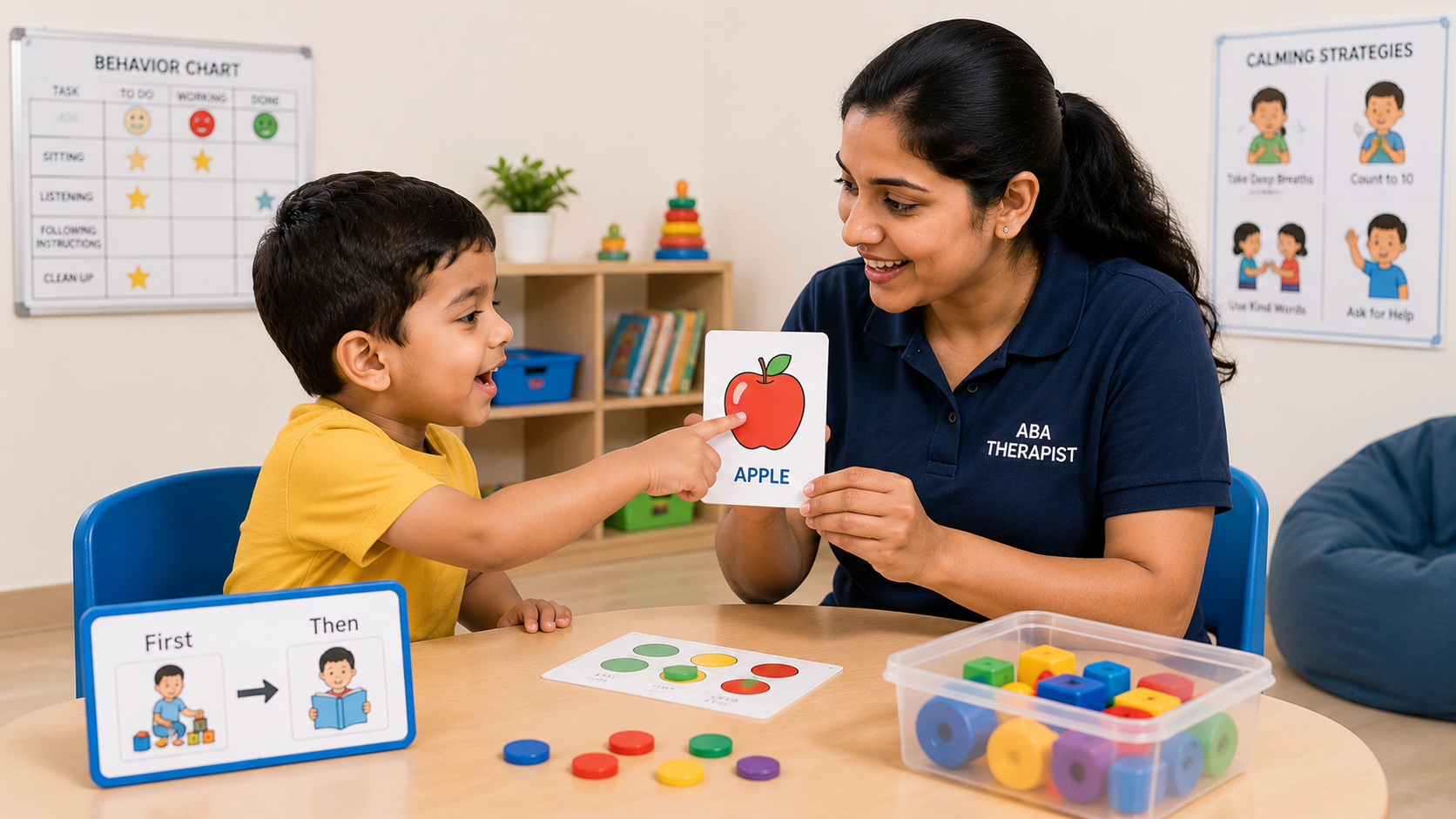
An ABA session with a young child at Kocoon Junior might look like this:
- The therapist sits with the child and uses preferred toys or activities to engage them
- When the child looks at the therapist, responds to their name, or attempts a word, they receive immediate, enthusiastic praise — and sometimes a preferred toy or sticker
- Over time, the therapist increases the expectation: a clearer word, a completed gesture, a two-step instruction — before the reward comes
- New skills are layered in gradually as earlier ones become consistent and automatic
Sessions are structured but also responsive. A skilled ABA therapist adjusts in real time based on what is working for that specific child on that specific day. Children do not experience sessions as drills — they experience them as play with a very engaged adult.
Which Children Benefit from ABA?
ABA is most commonly recommended for children with autism spectrum disorder (ASD), but it is also used effectively for children with:
- Communication delays (not yet speaking, or speaking with limited vocabulary)
- Challenging behaviours such as aggression, meltdowns, or self-harm
- Attention and focus difficulties
- Social skills deficits
- Daily living skill delays (dressing, eating, toileting)
ABA is particularly valuable for young children between ages 2 and 7, when the brain is in its most adaptable period for building new communication patterns and behaviours.
What Results Can Parents Expect — and When?
ABA produces results over time, not overnight. Here is a realistic picture of what families at Kocoon Junior typically experience:
After 3 months
Parents often notice the child responding more consistently to their name, making more eye contact, and having fewer frustration-driven meltdowns. Early requesting behaviours begin to emerge.
After 6 months
Communication improves noticeably — whether through words, gestures, or picture cards. The child begins to follow simple two-step instructions more consistently. Social engagement with familiar adults increases.
After 12 months
Many children show significant growth in language, social interaction, and daily living skills. Some children with autism who begin early, intensive ABA programmes reach developmental milestones that were previously thought unachievable.
Results depend on the child's starting point, the intensity of therapy (sessions per week), and how consistently strategies are applied at home by caregivers.
Common Myths About ABA Therapy
✗ Myth: ABA is robotic and stressful for children.
Modern ABA is play-based and child-led. Sessions at Kocoon Junior are designed to be engaging and enjoyable. Children do not experience them as clinical drills — they experience them as play with a skilled, attentive adult.
✗ Myth: ABA is only for children with severe autism.
ABA benefits children across the entire autism spectrum — from children who are non-verbal to children who are verbal but struggle with social interaction, emotional regulation, or learning.
✗ Myth: If you haven't started early, it's too late.
While earlier is always better, ABA can produce meaningful improvements at any age. We work with children from age 2 through their school years with positive outcomes across all age groups.
✗ Myth: ABA suppresses a child's personality.
Effective ABA builds on a child's strengths and interests. It does not aim to make children "normal" — it aims to give them skills that allow them to communicate, learn, and connect with the world on their own terms.
Is ABA Therapy Right for Your Child?
Book a free consultation with our ABA specialists at Kocoon Junior. We'll assess your child's specific needs and tell you whether ABA is the right approach — and what a programme would look like in practice.
Book Free Consultation →Taking the Next Step
If you are considering ABA therapy for your child, the first step is a free assessment. Our team at Kocoon Junior will review your child's current skills and challenges, explain whether ABA is the right fit, and outline what a programme would look like.
There is no referral needed, no commitment required, and the initial consultation is completely free.
Learn more about our ABA Therapy programme and our Autism Support programme at Kocoon Junior, or book your free consultation today.