
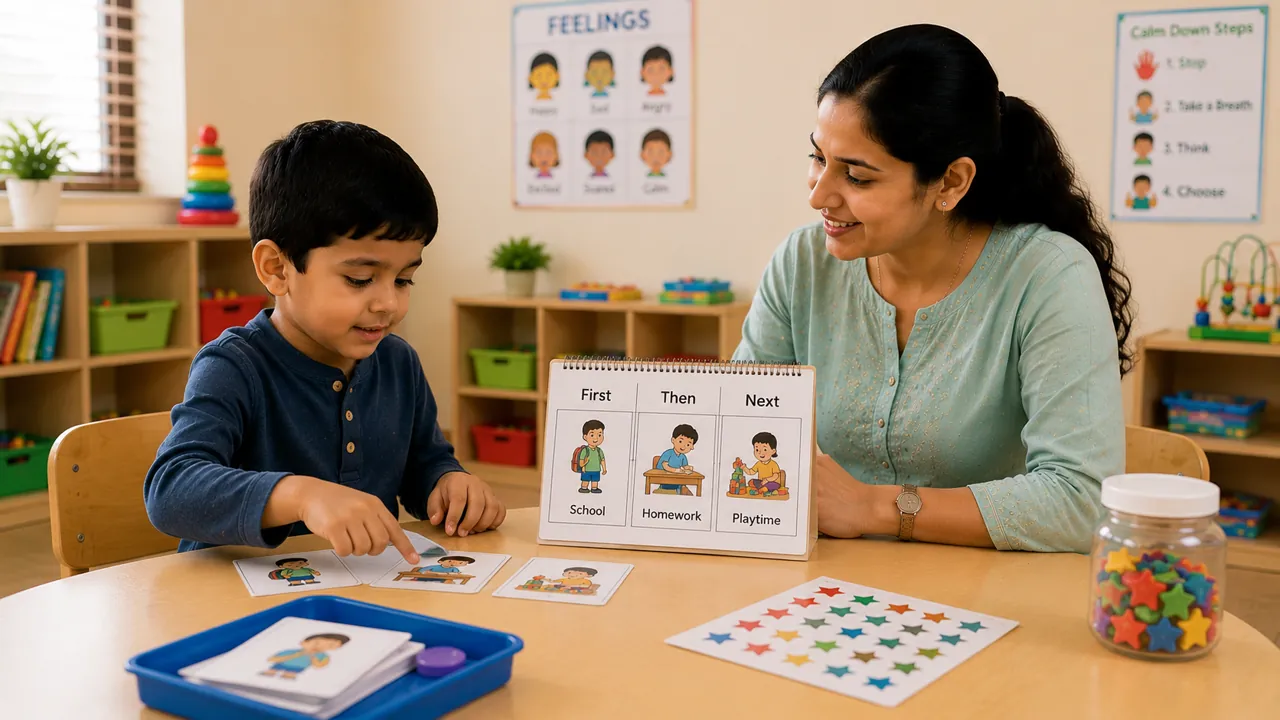
Applied Behaviour Analysis (ABA) is the most extensively researched therapeutic approach for children with autism spectrum disorder. It is also one of the most misunderstood. Some parents have heard it described as mechanical or repetitive. Others have been told it is the "gold standard" but have no idea what actually happens in a session. This article explains how ABA therapy works in practice — specifically, how visual schedules and structured learning are used at Kocoon Junior to build real-world skills in children with autism.
What Makes ABA Different
ABA is not a single technique — it is a framework based on the science of behaviour. At its core, ABA identifies the skills a child needs to build, breaks those skills into small, teachable steps, and uses systematic positive reinforcement to teach each step. Every behaviour has an antecedent (what happens before), a behaviour (the action), and a consequence (what happens after). By understanding and adjusting these three elements, ABA therapists can teach new skills and reduce behaviours that interfere with learning.
Modern ABA at Kocoon Junior is naturalistic, child-led, and play-based. It is not about making a child sit at a table and repeat drills for hours. It is about embedding learning opportunities into activities the child already enjoys — and gradually expanding their world from there.
Visual Schedules: Why They Matter for Autism
Many children with autism think in images rather than words. Their processing of language may be slower or less reliable than their processing of visual information. When a child cannot predict what will happen next, anxiety rises — and anxiety is one of the primary barriers to learning in autism.
Visual schedules are one of the most powerful tools in ABA therapy for this reason. A visual schedule is a sequence of pictures or symbols that shows the child what activities will happen in what order during a session or a day. The child can look at the schedule, see that "work time" is followed by "play time" and then "snack", and predict their environment. This reduces anxiety, reduces transition-related meltdowns, and frees up cognitive resources for actual learning.
At Kocoon Junior, every ABA session begins with the child reviewing their visual schedule with their therapist. As the session progresses, completed activities are removed or marked off — giving the child a continuous sense of progress and predictability.
What a Typical ABA Session Looks Like at Kocoon Junior
Each session is 45–60 minutes and follows a consistent structure tailored to the individual child's program:
- Arrival and schedule review: The child arrives, greets the therapist, and reviews the visual schedule for the session. This predictable opening routine reduces transition anxiety.
- Preferred activity warm-up: The session begins with an activity the child enjoys — often a favoured toy, game, or sensory activity. This builds rapport, motivation, and learning readiness.
- Discrete Trial Training (DTT) or Natural Environment Training (NET): Structured teaching trials targeting specific skills — language, social behaviour, play, self-care, or academic readiness — interspersed with preferred activities as reinforcement.
- Parent participation: Parents are present and observe the session. The therapist narrates what they are doing and why, and at the end of each session teaches parents specific strategies to practise at home.
- Cool-down and transition: The session ends predictably — the child can see on the schedule that it is ending. A consistent closing routine helps children transition back to their everyday environment without distress.
Is ABA Therapy Right for Your Child?
At Kocoon Junior, our ABA therapists begin with a comprehensive behavioural assessment to identify your child's specific learning profile, communication level, and the skills that will make the biggest difference to their daily life. Book a free first consultation.
Book Free ABA Consultation →Skills ABA Therapy Builds in Children with Autism
The specific goals in an ABA program are entirely individual. Common focus areas at Kocoon Junior include:
- Communication: Requesting using words, pictures, or devices; answering questions; initiating conversation; expanding vocabulary
- Social skills: Making eye contact; responding to their name; turn-taking; engaging in play with peers
- Daily living skills: Dressing independently; washing hands; toileting routines; managing mealtimes
- Learning readiness: Sitting for a task; following two-step instructions; imitating actions; attending to a shared object
- Reducing interfering behaviours: Identifying the function of behaviours like tantrums, self-stimulation, or aggression, and teaching functional alternatives
The Role of Parents in ABA at Kocoon Junior
ABA therapy is most effective when parents are active partners. At Kocoon Junior, parent involvement is not optional — it is integral to the program. Parents are present in sessions, learn the specific strategies their therapist uses, and implement them at home throughout the week. This means the child's ABA program runs not just 5 hours a week in the clinic, but throughout their daily routines — mealtimes, bath time, play time, getting ready for school.
Parents often report that their own confidence increases alongside their child's skills. Understanding why their child behaves the way they do — and having specific, evidence-based tools to respond — transforms the daily experience of parenting a child with autism.
What Results Are Realistic?
ABA therapy does not have a fixed endpoint or guaranteed outcome — every child with autism is different, and their response to therapy is equally individual. What the research consistently shows is that children who receive high-quality ABA therapy early make meaningful, measurable gains in communication, social behaviour, and adaptive skills. Many children make gains that allow them to participate more fully in mainstream school settings. Some achieve outcomes their parents did not think possible.
Kocoon Junior sets goals collaboratively with families — goals that are specific, measurable, and relevant to the child's real daily life. Progress is reviewed every 4–8 weeks, goals are updated, and families receive written summaries of what is being achieved.