
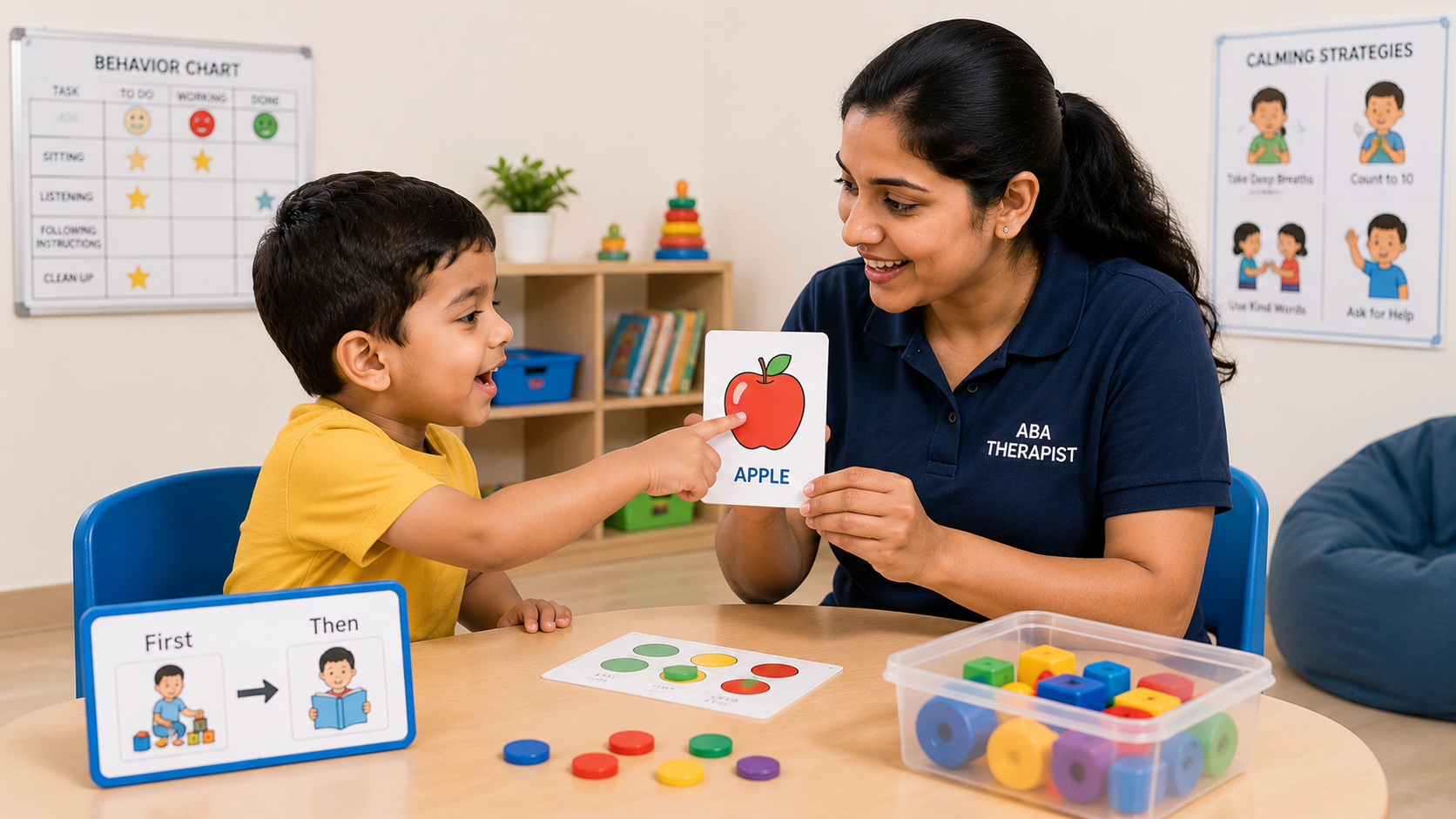
Parental instinct is remarkably accurate. When parents come to Kocoon Junior saying "something feels different about my child," they are right more often than they are reassured out of their concerns. If you have noticed something in your toddler's development — in their eye contact, their response to their name, the way they play, or the way they handle sensory experiences — this article is for you. It will not diagnose your child. Only a qualified clinician can do that. What it will do is give you a clear, practical picture of the early signs that developmental specialists look for in toddlers aged 12–36 months.
Why Early Identification Matters So Much
The brain is never more plastic — more able to form new connections and pathways — than it is in the first three years of life. Early intervention for autism does not change who a child is. It harnesses this neurological window to build skills — communication, social connection, adaptive behaviour, play — at the stage when they are most teachable. Children who receive evidence-based early intervention consistently show better long-term outcomes in language, cognitive development, and independent functioning than those who receive the same intervention later.
This is why the message from every developmental specialist is the same: if you have a concern, act on it now. Waiting to see if a child "grows out of it" uses up the most valuable developmental time.
Autism Signs at 12–18 Months
The earliest reliable signs of autism often emerge in the first 12–18 months, though they can be subtle and easy to miss at this stage.
12–18 Month Checklist
- Does not consistently respond to their name when called (by 12 months)
- Does not babble with varied consonant sounds ("ba", "da", "ma") by 12 months
- Does not wave bye-bye or clap hands by 12 months
- Does not point to things to show interest — pointing to a dog, a plane, something exciting — by 14–16 months
- Does not follow the direction of a pointed finger to look at what you are pointing at
- Makes very little eye contact, or eye contact that feels unusual — brief, fleeting, or overly intense
- Shows reduced or absent social smile — smiling back when you smile at them
- Does not bring objects to show you — does not initiate shared attention
- Shows little interest in other children
Autism Signs at 18–24 Months
By 18 months, language and social development are clearer to observe — and so are the patterns that may indicate autism spectrum disorder.
18–24 Month Checklist
- Has fewer than 10 words by 18 months, or has lost words they previously used (regression)
- Does not use two-word combinations by 24 months (e.g., "more milk", "daddy go")
- Does not engage in functional pretend play (e.g., pretending to feed a doll, using a toy phone to "talk")
- Lines up toys repeatedly rather than playing with them imaginatively
- Becomes very upset when routines are disrupted — the same route to school, the same placement of objects
- Repetitive body movements — hand flapping, rocking, spinning — that occur frequently and are difficult to redirect
- Strong, unusual attachment to specific objects (not a comfort blanket — unusual objects carried everywhere)
- Unusually intense reactions to sensory input — covering ears for moderate noise, gagging at textures, distress at certain clothing fabrics
- Does not point to body parts or pictures in books when asked by 18–24 months
Concerned About Your Toddler?
Kocoon Junior offers developmental assessments for children from age 2. Our specialists can tell you clearly whether what you are observing warrants further evaluation, and what your next steps should be. Book a free first consultation.
Book Free Assessment →Autism Signs at 24–36 Months
By two to three years, a child's social and communication development is visible in daily settings — at home, at playgroup, in public. Parents and family members often notice a growing gap between their child and peers at this stage.
24–36 Month Checklist
- Speech that is not clearly understandable to unfamiliar adults by age 3
- Repeating phrases from videos or books (echolalia) without using language to communicate meaningfully
- Referring to themselves by name instead of "I" or "me" ("Aryan wants water" rather than "I want water")
- Little or no interest in other children — preferring solitary activity even in group settings
- Not responding to simple questions or two-step instructions reliably
- Very rigid play patterns — toys must be in exact positions, same sequences repeated
- Fascination with parts of objects (spinning the wheels of a toy car rather than playing with the car)
- Unusual food refusal based on texture, colour, or presentation — eating from a very narrow range of foods
- Difficulty with transitions — moving from one activity to another causes consistent, intense distress
- Walking on tiptoes beyond age 2.5 without a physical explanation
Important: These Signs Are Not a Diagnosis
This checklist reflects the kinds of signs that developmental specialists observe — but context matters enormously. Some children show several of these signs and do not have autism. Some children with autism show few of the classic signs until later. A late talker might be a late talker. A child who lines up toys might simply be a child who likes order.
What matters is the pattern, frequency, and impact of these signs — and whether they represent a consistent difference across multiple domains (language, social interaction, play, sensory response, behaviour) rather than isolated quirks.
Only a qualified developmental professional — a child psychologist, developmental paediatrician, or specialist team — can carry out a diagnostic assessment. What you can do is bring your concerns to that assessment promptly.
Red Flags That Warrant Immediate Assessment
Regardless of age, contact a developmental specialist immediately if your child:
- Loses language or social skills they previously had at any age (regression)
- Does not babble by 12 months
- Does not speak any words by 16 months
- Does not use two-word phrases by 24 months
- Shows no response to their name by 12 months
These are established red flags recognised across international paediatric guidelines. Regression — the loss of skills — is particularly important and should always be investigated promptly.
What Happens After You Raise a Concern?
Many parents worry about what raising a concern will lead to — a label, a judgment, or a path they can't take back. In reality, assessment leads to clarity, and clarity leads to the right support. You do not need a diagnosis to start early intervention — at Kocoon Junior, we can begin speech therapy, ABA therapy, and developmental support based on a child's observed needs, regardless of whether a formal diagnosis is in place.
Our process begins with a free first consultation. A specialist will listen to your concerns, observe your child, and explain clearly what they see, what they recommend next, and why. There is no pressure, no commitment, and no judgment. There is only information — and a clear path forward.
The Most Important Thing You Can Do Right Now
Trust your instinct. Parents are the best observers of their own children. If something feels different — if your child is not doing things you expected them to do by now, if interactions feel effortful in a way they don't with other children, if you find yourself searching the internet at midnight for answers — those feelings are data. They are worth acting on.
Early action is the single most powerful thing a parent can do. The window it opens is real, and the outcomes it changes are meaningful. Kocoon Junior has been supporting children with autism and their families across Ahmedabad for over 20 years. We are here to help you understand what you are seeing and to walk the next steps with you.