
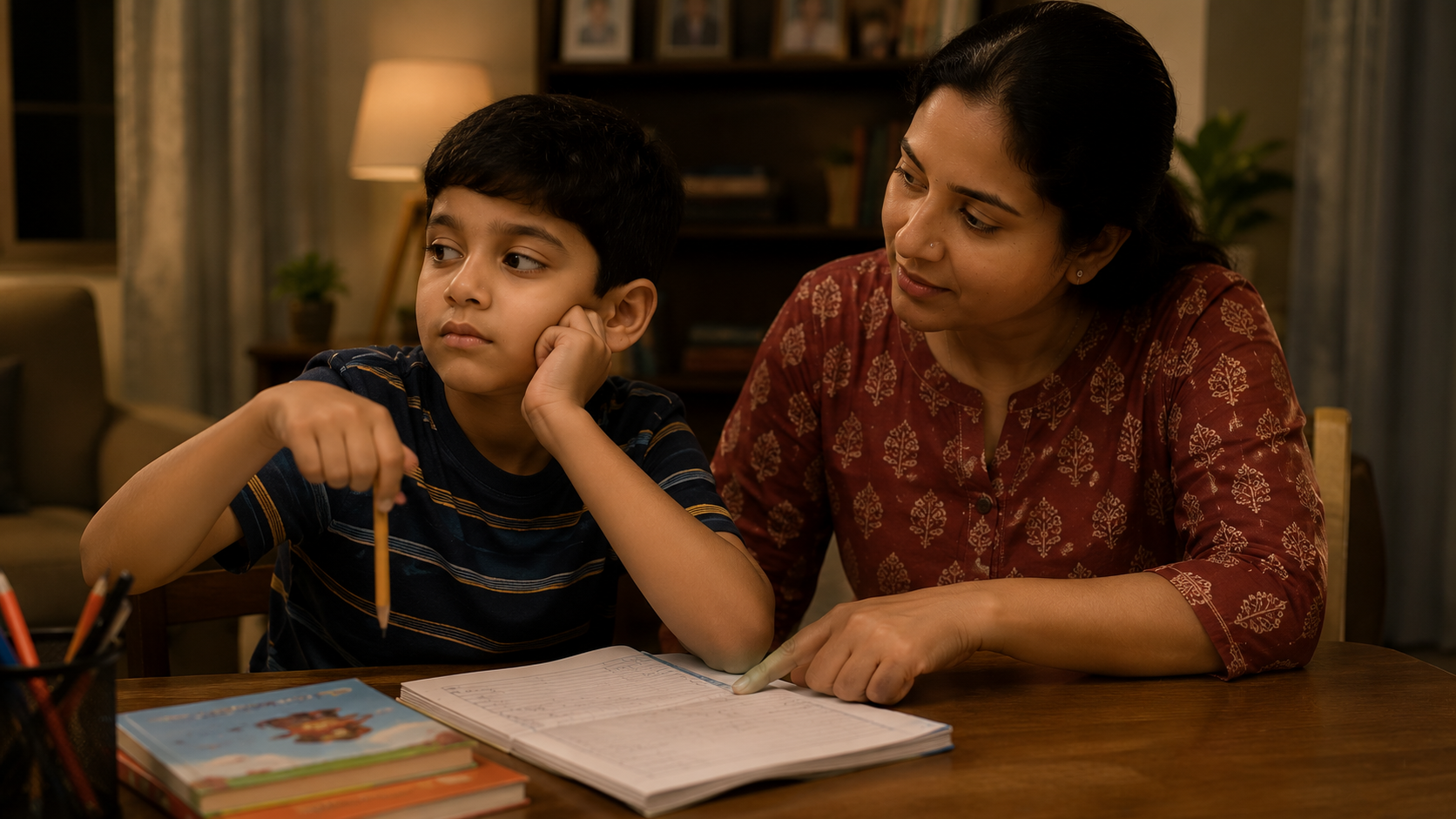
If your child can't sit still, loses focus within minutes, reacts explosively, or bounces between activities without completing anything — you're not alone. Hyperactivity is one of the most common concerns raised by parents of children aged 2 to 10 at Kocoon Junior.
This article gives you practical strategies you can use at home starting today. It also helps you understand when home strategies have limits — and when professional support is the right next step.
Is It ADHD or Just High Energy?
Not all hyperactive children have ADHD — and not all children with ADHD are obviously hyperactive. Some children are simply wired with more physical energy and less tolerance for sitting still than their peers. This is normal variation.
ADHD becomes a clinical concern when hyperactivity, impulsivity, or inattention is:
- Present in more than one setting — at home AND at school, not just one
- Causing significant difficulty in daily life — learning, relationships, or self-care
- Inconsistent with the child's developmental age
If your child is bouncy at home but focused and happy at school, it is less likely to be ADHD. If both family and teachers are raising concerns — that warrants a proper assessment.
7 Practical Strategies You Can Use at Home
Shrink the task, shrink the resistance
Hyperactive children struggle with tasks that feel large or open-ended. Instead of "do your homework," try "write the first 3 answers." Instead of "clean your room," try "put all the toys in the box." Small wins build momentum and reduce the refusal that comes from feeling overwhelmed.
Use a visual timer, not verbal countdowns
Abstract time ("10 more minutes!") is almost meaningless to a hyperactive child. A visual timer — where they can see the remaining time as a shrinking area — creates a concrete, manageable boundary. Many parents find 10-minute focus intervals effective, with short movement breaks in between.
Movement before concentration
Physical activity before focused work is one of the most consistently effective strategies our occupational therapists recommend. A 10-minute outdoor play session or jumping before homework makes a measurable difference in focus quality. Movement regulates the nervous system — it is not a reward, it is preparation.
Reduce sensory distractions in the workspace
Hyperactive children are often sensitive to background stimuli. A workspace facing a plain wall (not a window), with no TV or sibling noise in the background, and minimal visual clutter on the desk, genuinely changes how much cognitive energy is available for the task at hand.
Give choices, not commands
"Sit down and do your work" triggers resistance. "Do you want to start with maths or English?" gives the child a sense of control and reduces power struggles. The task still happens — the child simply chose the order. This works especially well for transitions, which are some of the hardest moments for hyperactive children.
Praise effort immediately and specifically
Hyperactive children need immediate, specific positive feedback. Not "good boy" — but "I noticed you sat for 5 whole minutes without getting up. That's really hard and you did it." Praise must be specific and immediate to register. Delayed praise doesn't connect to the behaviour you're reinforcing.
Maintain consistent, predictable routines
When children know exactly what comes next — wake, breakfast, school, homework, play, dinner, bath, bed — they spend less mental energy on transition anxiety. Unpredictable schedules are harder for hyperactive children to regulate through. The routine itself becomes a regulatory tool.
What Not to Do
These common responses make hyperactivity worse, not better:
- Punishing fidgeting or movement — much of it is involuntary and neurological, not defiance
- Eliminating all screen time without providing a physical alternative — boredom escalates dysregulation
- Comparing your child to siblings or classmates — this increases shame without improving behaviour
- Expecting long focus sessions immediately — build up from 5 minutes, not down from 30
- Using sarcasm or frustration-driven comments — the child internalises these as identity, not as feedback
When Home Strategies Aren't Enough
Home strategies help — but they have real limits. If your child's hyperactivity is:
- Significantly affecting school performance or social relationships
- Causing daily conflict in your family that isn't improving
- Getting worse over months, not better
- Accompanied by emotional outbursts, sensory sensitivities, or learning difficulties
...then professional assessment is the right next step. At Kocoon Junior, our occupational therapists and psychologists assess hyperactivity comprehensively and create a programme that addresses the specific pattern — whether it is sensory-driven, ADHD-related, or both.
The sooner you understand the root cause, the sooner the right support can be put in place. Home strategies work better once you know what you are actually working with.
Not Sure Why Your Child Struggles to Focus?
Book a free 30-minute consultation with our team at Kocoon Junior. We'll assess your child's specific pattern and tell you what is actually driving the behaviour — and what to do about it.
Book Free Consultation →Taking the Next Step
Learn more about our Hyperactive Child programme and our Occupational Therapy programme at Kocoon Junior — available at all 3 Ahmedabad centres.
Book Your Free Consultation